


 21 / 24

 www.SullivansIslandMagazine.com
|
www.SullivansIslandHomes.com21
mutual employer folded, she lined up work as the official
staff photographer for Vice President Al Gore. Later, she
would enjoy unprecedented access to the Obama family.
Though her political work kept the couple in the Wash-
ington, D.C., area for eight years, eventually they moved
down the coast
to Sullivan’s
Island. A native
of Georgia,
Shell attended
the College of
Charleston.
“We were
returning home
for her as much
as it was a new
home for me,”
Musi explained.
“I’m only al-
lowed to live
south of the
Mason-Dixon
line because of
her.”
Musi began
contributing
photographs
to
National
Geographic
dur-
ing the family’s
time in the
D.C. area. His
topics tended
to be human or man-made. He photographed life under
a volcano in the West Indies, along historic Route 66,
across the Texas Hill Country and at an archaeologi-
cal site in Turkey. Over an eight-year period, starting
in 2006, when he was actually in-country and in-town,
Musi worked south of Charleston, on a spread celebrat-
ing the beauty of South Carolina’s ACE Basin. That
spread would finally be published in the November 2014
edition of
National Geographic,
and, that autumn, Musi
presented an exhibit of the project’s fruits at the Charles-
ton Library Society downtown.
Musi’s own photography heroes include people such
as Stan Grossfeld, the two-time Pulitzer Prize-winning
photographer for
The Boston Globe,
who “uses photogra-
phy to affect people’s lives” and “tells stories of people in
need.” However, For several years, Musi’s own work for
National Geographic has focused primarily on animal
portraits.
Animals can make difficult subjects, and they weren’t
in Musi’s comfort zone, but
National Geographic
has a
long history of animal photography. Musi soon found
himself taking pictures of chimps, fish and hedgehogs for
one of the world’s most well-known magazines.
“The idea was eye contact. I was going to be the An-
nie Leibowitz of animal photography,” he joked in his
2014 TEDx talk.
But his first efforts met with disaster, until Musi liter-
ally learned to talk to the animals.
“I found my inner Dr. Doolittle,” he explained.
Today, when not away on assignment, Musi is most
likely to show up at High Thyme, his favorite island
haunt. But his work will continue to be elsewhere.
“I wish things were different,” he said, “but I’m not
able to work much in the Lowcountry. Even so, the land-
scape and people have been a great inspiration.”
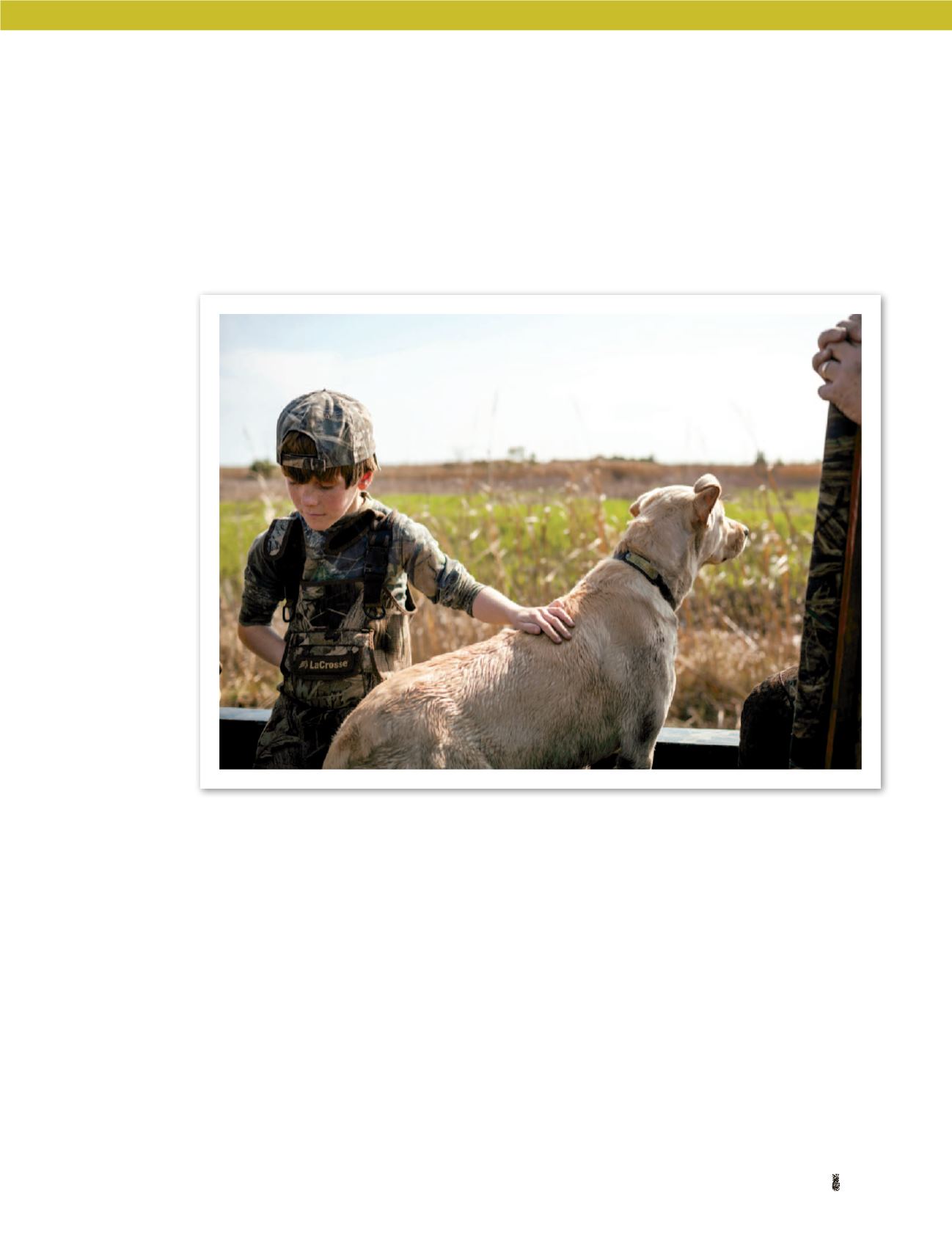
Young J.D. Cate takes a break following an early morning duck hunt with his father and the family’s retriever, Henry.
Hunting waterfowl and other game is a cherished tradition in the ACE Basin, spanning generations and
spurring conservation efforts. South Carolina’s ACE Basin is one of the largest undeveloped estuaries on the East
Coast. This photograph was part of long-term essay on the region originally published in
National Geographic.
Photo by Vincent J. Musi.