


 19 / 24

 www.SullivansIslandMagazine.com
|
www.SullivansIslandHomes.com19
Principal Susan King explained that being a partial
magnet “allows us to really capitalize on our location to
motivate kids to explore and have a better understanding
about their environment.”
The partial magnet status also enables the school to
have two science teachers and allows the school to accept
children from outside its zoned area. This group makes up
about 30 percent of the student body, according to King.
“We encourage teachers to use
the outdoors as a classroom and
embed coastal themes in regular
programs,” King said.
For Rhodes and Rambo, the
emphasis on the environment
creates an ideal situation to take
advantage of the unique opportu-
nities offered at Sullivan’s Island
Elementary. A nearby boardwalk
leads to beachcombing expedi-
tions, and an entire grade par-
ticipates in a “Seeds to Shoreline”
program that involves re-planting
native spartina grass in the marsh.
A nature trail behind the school
lets students walk in the woods
and discover a variety of species.
“When we take classes on the trail, we ask, for ex-
ample, ‘Why is a maritime forest important?’ and kids can
see how it protects this barrier island and their homes,”
Rambo said. “To be able to see that visually is important
and makes the light bulb come on, the connection about
how their surroundings affect their lives.”
Inside the Wet Lab, three 50-gallon touch tanks con-
tain aquatic ecosystems found along the South Carolina
coast – freshwater; salt marsh estuary; and near-shore –
and the 100-gallon “Mac Daddy” tank holds plants and
animals from the ocean. Later this year, the teachers plan
to fill the tanks with non-indigenous ecosystems so stu-
dents can study and identify foreign species and different
regions, such as the Pacific tropical coast.
Some of the creatures caught while seining – dragging a
30-foot net with two wooden poles parallel to the shore to
catch an array of species – are brought back to the tanks in
the classroom for a short time. Rhodes and Rambo try to
take the students at least once in the fall and spring for what
always proves to be an exciting school outing.
The kids help drag the net
along the beach, then are able to
touch and examine the fascinat-
ing creatures isolated in the net
– everything from fish and crabs
to jellyfish and stingrays. The
children learn about the variety of
marine life and how to properly
handle each species.
“The kids are able to identify
almost everything on the beach;
it’s amazing,” said Rhodes, who
teaches the younger students in
pre-k through second grade, while
Rambo works with grades three
through five.
Both educators have been at
the school since the new building
opened three years ago, but this is their first year teaching
science together. Rhodes and Rambo work closely to co-
ordinate the use of the labs and collaborate with the other
teachers while planning lessons for nine-week science units
that rotate throughout the year.
“It’s such an awesome opportunity to have the separate
labs. We have more space and resources available, and we can
make a big mess,” Rhodes said. “Having the science teachers
co-teach with classroom teachers is crucial for learning.”
King added: “Teaching children to be careful observ-
ers and problem solvers translates to different areas of
connection.”
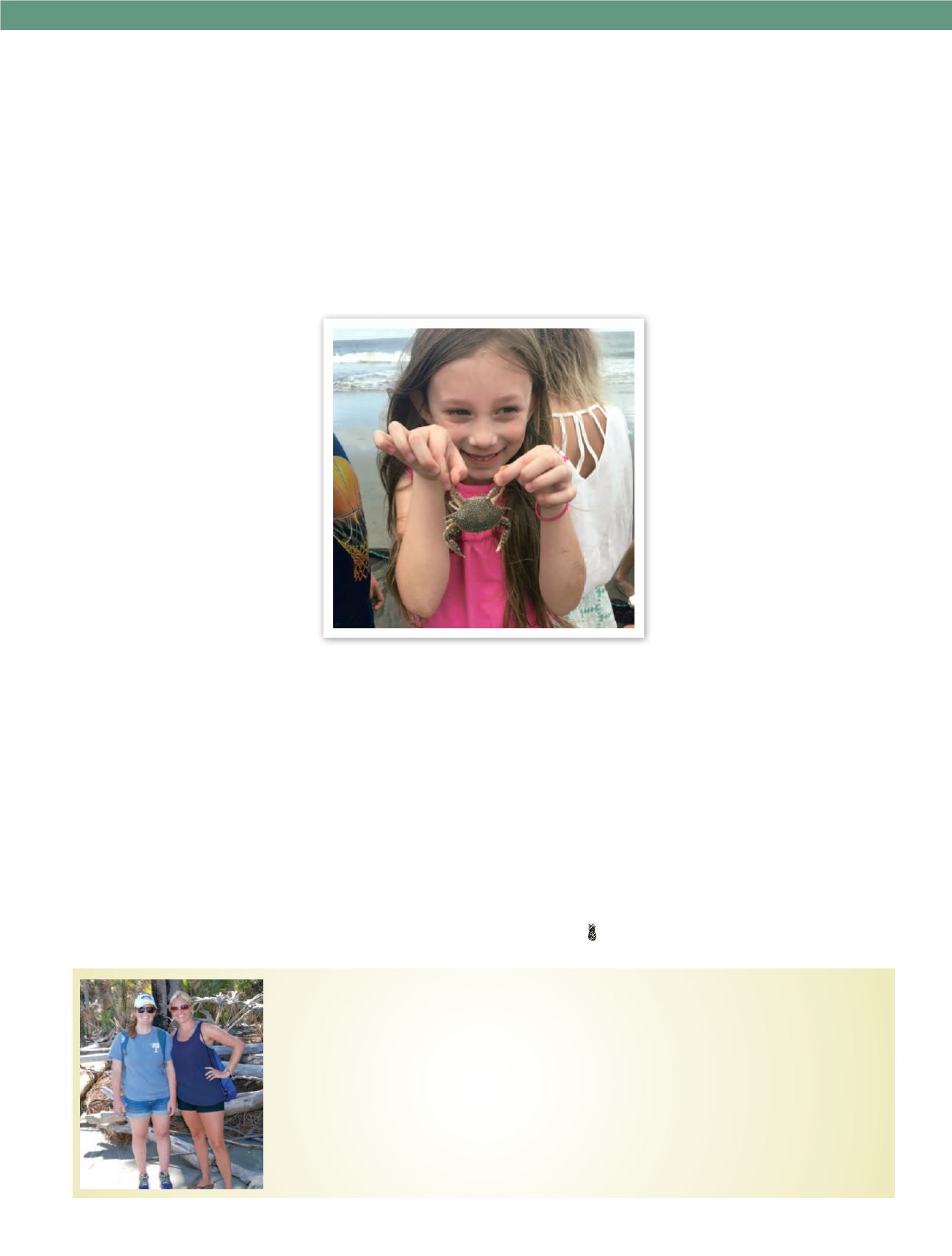
Kids are able to examine the fascinating
creatures they catch while seining.
Important partnershIps
Rhodes and Rambo see establishing
and maintaining partnerships in the
community as a valuable way to expand
knowledge about the coastal environ-
ment. Some of the school’s partnerships
include Chris Crowley with Coastal
Expeditions, who helps with seining and
other trips; the Greenheart program,
which assists with the garden in front of
the school, which helps teach children
about soil, planting seeds and growing
crops; and SC Coastal Friends, which,
through the Sewee Center in Awendaw,
is able to bring animals – including birds
and baby alligators – to the school and
arrange for fifth graders to visit the cen-
ter several times a year.