


 14 / 24

 www.SullivansIslandMagazine.com
|
www.SullivansIslandHomes.com14
of the National Park Service. That’s because it comes under
the auspices of Fort Sumter. Yet Fort Moultrie is the only
location in the National Park System that can boast a
role in the 171-year history of America’s seacoast defense.
Doesn’t such a legacy deserve more recognition? Well, it’s
about to get it.
Currently, consideration is being given to renaming
Fort Moultrie – along with
Fort Sumter – a national park.
Although the two forts will still
be linked and no additional
funds will be appropriated from
the federal government for them,
their designation as a national
park will certainly give both forts
a more prominent title, likely
leading to more publicity.
Nearly 15 years ago, former
U.S. Sen. Strom Thurmond
pushed unsuccessfully to change
both Fort Moultrie and Fort
Sumter from national monu-
ments to national parks. Now, U.S. Sen. Tim Scott is
renewing that effort.
According to Tim Stone, superintendent at
the Fort Sumter National Monument, the
difference between a national monu-
ment and a national park is really just
semantics. But it seems to make a
difference when it comes to park
awareness. In the world of Google,
travelers typically will search the
Internet for “national parks” rather
than for any of the other sites man-
aged by NPS. Some national parks,
including Congaree, saw an increase
in attendance when their names were
changed. So the new moniker can mean
a lot.
And there is even more good news for the
island’s crown jewel. Fort Moultrie has been chosen
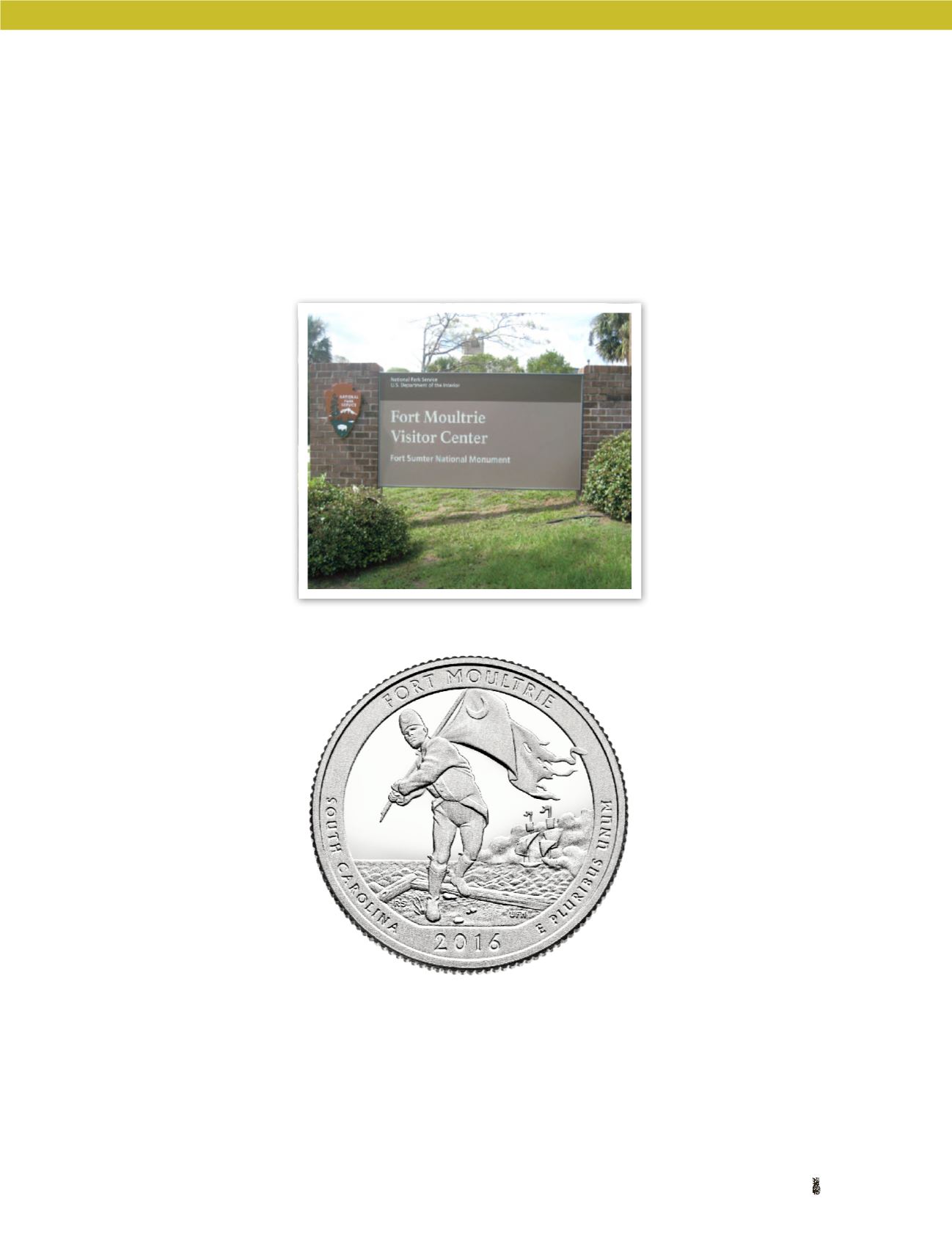
as one of the new designs for quarters that are part of the
America the Beautiful Quarters Program. Eight years ago,
the U.S. Mint began issuing coins each year featuring
five different national parks and other national sites. The
designs are depicted on the tails side of the quarters. The
upcoming Fort Moultrie coin has the iconic image of Sgt.
William Jasper replacing the flag on the palmetto fort at
the battle of Sullivan’s Island in June 1776. With the fort
as the focus of one of the new designs, even more recogni-
tion and acclaim is sure to head its way.
On Nov. 17, federal and state dignitaries will attend
a special program (open to the public) for the unveil-
ing of the coin’s design. Local performers and speakers
will also be on hand to add to the festivities. The newly-
minted Fort Moultrie quarters will be available for sale,
and schoolchildren in attendance will each receive a free
quarter. Teachers can obtain free
online lesson plans focusing on
the significance of the fort and
of Sullivan’s Island.
The Sullivan’s Island Light-
house and the historic U.S. Life
Saving Station won’t be left out
of the 100th anniversary celebra-
tion. The lighthouse, the last
major light built on the Eastern
shore of the United States, was
completed in 1962 and has been
part of the National Park Service
for over 25 years. Even the dunes
and beach from the lighthouse
area to the high-water mark are protected by the National
Park Service. The property includes a two-story quarters
building and a boathouse with board and batten
siding, typical of 19th century Coast Guard
architecture. In the early 20th century,
a sighting station, signal tower and
garage were added. This was the only
lifesaving station built in South
Carolina. The entire complex is
listed on the National Register of
Historic Places.
Today, the Park Services uses
the buildings. However, the histor-
ic boathouse has been restored, and
the NPS plans to add exhibits inside
to tell the story of the U.S. Life Saving
Service on the island. The structure will
then be open to the public.
According to Sullivan’s Island Town Administrator
Andy Benke, “The town is very fortunate to have the presence
of the National Park Service on the island. The rehabilitation
of Fort Moultrie sets the tone for and complements the his-
toric preservation efforts on Sullivan’s Island in so many ways.
Moreover, the work by the Park Service offers visitors and
residents of Sullivan’s Island a rare glimpse into the various
periods of coastal defense by our nation.”
So the next time you’re thinking of visiting a national
park, don’t forget to look in your own backyard.