


 20 / 28

18
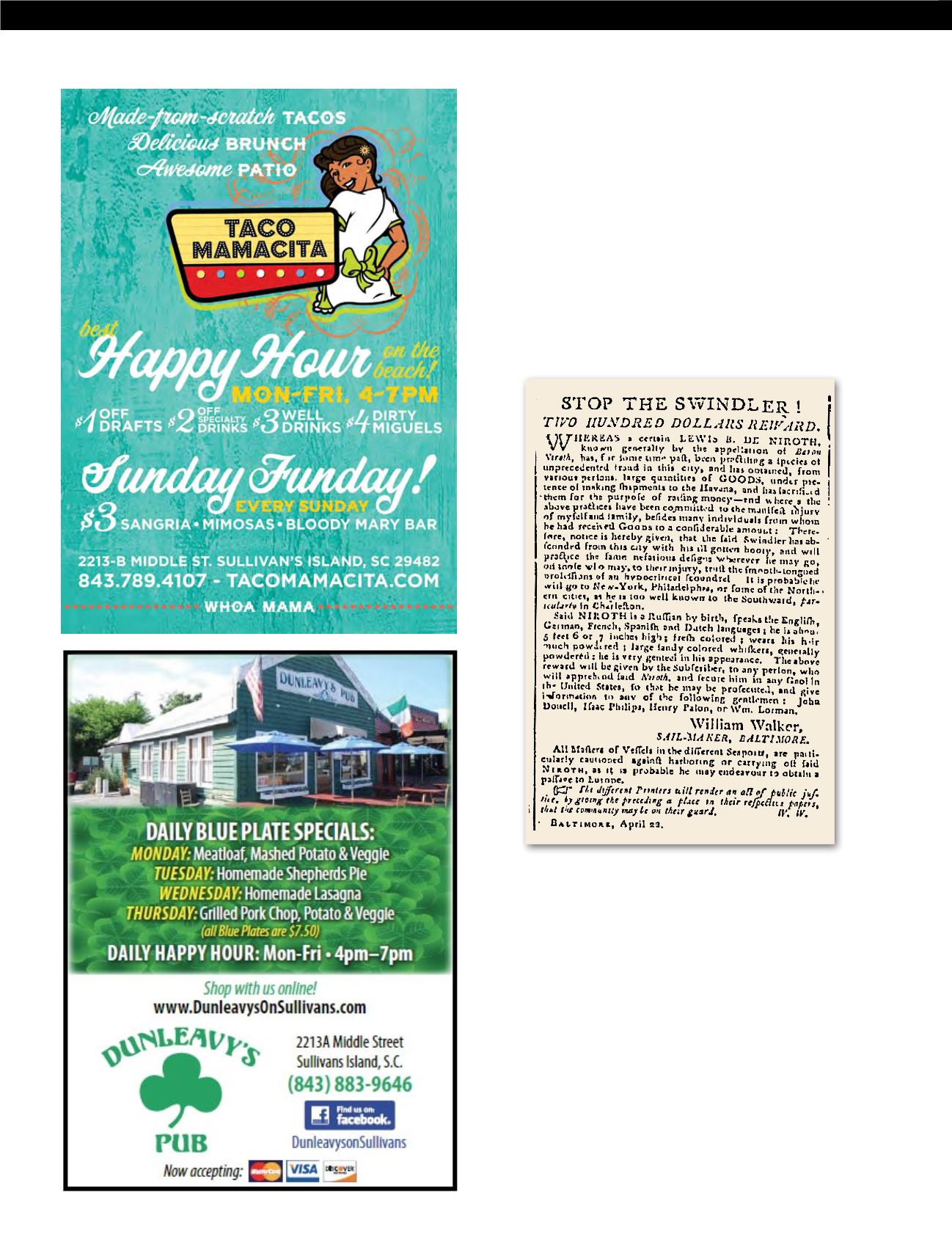
suits for unpaid debts, and, unable to pay workers, Niroth
attempted to work alone. Receiving minimal help from “a
gentleman of Charleston,” he was able to begin the process
of salt production. However, the weight of the pending
suits soon resulted in his arrest and incarceration. The
Baron was released but only after some 16,000 bushels of
brine were lost. In an attempt to resurrect his salt works,
he petitioned the state of South Carolina for six acres and
$2,000 for three years. In order to obtain the relief, he was
required to become a citizen. In doing so, he declared that
he was a native of the Duchy of Litherania, not England.
He was granted the title of denizen – a cross between an
alien and a full citizen.
By September 1801, Niroth had disappeared from
Charleston and from South Carolina, once again leaving
angry creditors behind. Salt production on Sullivan’s
Island disappeared forever. The salt works and large
home were sold in 1805 by the remaining creditors. The
land later was to become the oyster plantation of David
Truesdell in the 1830s.
Numerous salt works would later appear in Mount
Pleasant and Charleston, but none were successful.
Unfortunately, small salt works probably were doomed
by their size alone. The salt works at Baynes, in the
South of France, covered nearly 371 acres and yielded
www.SullivansIslandMagazine.com|
www.SullivansIslandHomes.com|
www.SullivansIsland.co